

Textile EPR in the EU: Fees, Registration and Deadlines
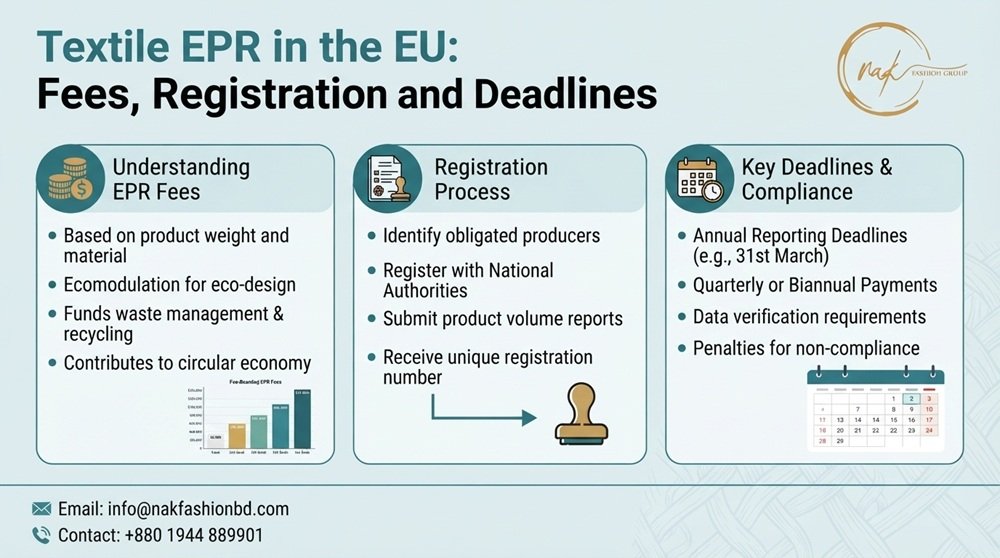
Textile EPR compliance for EU clothing brands is the one incoming obligation that shows up directly in your P&L rather than in a report. Extended producer responsibility makes whoever first places a garment on a national market pay for its collection, sorting, reuse and recycling at end of life. Under the revised Waste Framework Directive, every EU member state must have a textile EPR scheme in place by June 2027.
That is a per-unit cost on everything you sell, in every country you sell it in, plus a registration and reporting obligation in each. It is not a disclosure exercise you can absorb into an existing sustainability workflow.
The good news is that it is knowable in advance and partly controllable through product decisions. The bad news is that the cost is real, recurring and country-by-country.
What EPR actually shifts
Textile waste collection and sorting has historically been funded by municipalities and charity-sector operators. EPR moves that cost to producers on a polluter-pays basis. In exchange, producers get a defined obligation: register, declare volumes, pay fees, and let the scheme handle operations.
The fee funds collection, sorting, reuse channels and recycling. Sorting textiles is labour-intensive and the recycled-fibre market is thin, so these are not trivial sums per tonne — which is why fee schedules reward products that are cheaper to handle at end of life.
This is distinct from the reporting and due diligence rules brands often bundle it with. EPR is about waste and money. Product-level data obligations sit with the Digital Product Passport.
Textile EPR compliance for EU clothing brands: what has to happen by June 2027
| Step | What it involves | When to start |
| Identify obligated markets | Every member state where you place goods on the market, including distance sales | Now — it drives everything else |
| Appoint a representative | Non-EU sellers typically need an authorised representative per country | 6–12 months before a scheme opens |
| Register as a producer | National register entry, usually with a unique producer number | As each national scheme opens, ahead of June 2027 |
| Join a compliance scheme | Contract with the national producer responsibility organisation | At registration |
| Declare volumes | Units and/or weight by product category, periodically | From first placement after scheme start |
| Pay fees | Per-unit or per-kilo tariff, set nationally | Ongoing |
| Report and reconcile | Annual declaration, subject to audit | Annually |
Two structural points to plan around. Schemes are national, not EU-wide — obligations, categories and tariffs are set per member state, so a brand selling into six countries has six registrations and six declarations. And several member states already run textile EPR ahead of the directive deadline, so “June 2027” is a backstop, not a start date. If you sell into a country that is already live, you may be obligated now.
Who counts as a producer
The definition catches more parties than brands expect. In broad terms, the producer is the first party to make the product available on a national market — which can be:
- A brand manufacturing or importing under its own label.
- An importer or wholesaler bringing in third-party goods.
- A non-EU seller shipping directly to EU consumers, including through a marketplace. Distance selling into the EU is explicitly in scope, which closes the loophole that let overseas online sellers avoid national schemes.
- In some markets, the online marketplace itself, where the seller has not registered.
For a European brand importing from Bangladesh, this matters in an easily missed way: your Bangladeshi supplier is not the producer, and neither is your buying house. The obligation attaches to you at the point of placing goods on the market. What the supply chain can affect is the size of the fee, not who pays it.
What fees are based on, and how eco-modulation works
Fees are typically calculated per item or per kilogram, by product category, at rates set by each national scheme. Do not budget from a single European figure — build your model per market once tariffs publish, and treat any current number as indicative and subject to annual revision.
The part worth engineering around is eco-modulation. Schemes adjust the tariff up or down according to product characteristics, so two t-shirts with the same wholesale price can carry different fees. The criteria vary by country, but the direction is consistent:
| Attribute | Typical fee effect | Why |
| Durability (construction, colourfastness, pilling performance) | Lower | Longer first life, higher reuse value |
| Mono-material composition | Lower | Mechanically recyclable without fibre separation |
| Blended fibres, especially cotton–elastane and cotton–polyester | Higher | Hard to recycle with current technology |
| Recycled content, verifiably declared | Lower | Rewards secondary-material demand |
| Disruptive components (metal trims, mixed-material zips, heavy coatings, bonded prints) | Higher | Complicate sorting and shredding |
| Repairability and spare-part provision | Lower | Extends first life |
| Chemical restrictions met | Lower or eligibility condition | Recyclate must be safe |
None of this is exotic. It is the same product logic already showing up in ESPR performance standards — durability, recyclability, recycled content — arriving with a price attached sooner.
Design and sourcing decisions that reduce the fee
These are decisions taken at tech pack and fabric booking, which means they belong to your product team and your supplier before the season, not to finance afterwards.
- Cut incidental elastane where the garment does not need stretch. A 5% elastane addition in a basic tee can move a product from recyclable to non-recyclable classification.
- Prefer mono-fibre constructions for high-volume basics — t-shirts, sweatshirts and polo shirts are where volume makes small per-unit differences material.
- Standardise trims to a single material family per garment, and avoid bonded or heavily coated finishes on otherwise recyclable fabric.
- Specify durability performance in the tech pack — pilling, colourfastness and seam-strength targets — so you can evidence a durability claim rather than assert it.
- Document recycled content properly, with transaction certificates, not just a mill’s statement.
- Record component weights per style. Fee declarations are weight-sensitive in several markets, and estimating weights across a range after the fact is expensive.
The last one is the cheapest to implement and the most often skipped. Ask for a weighed net garment weight per size, per style, at pre-production sample stage.
How it interacts with landed cost
EPR fees sit outside FOB and outside freight — they attach when you place goods on a national market. Treat them as a separate line in landed cost per market, alongside duty and clearance, rather than trying to push them into the supplier’s price. A supplier cannot absorb a fee it is not legally exposed to, and pretending otherwise just produces an unrealistic quote. Our FOB price breakdown shows what does and does not belong in a factory’s number.
Where sourcing genuinely helps is upstream: fibre choice, trim standardisation, weight control and verified recycled content are all supplier-side decisions with a direct fee effect. Factories used to European technical requirements — including the audited, green-certified units Bangladesh has invested heavily in — handle these specifications as routine.
Working with a buying house on this
Fee reduction is a specification problem, and specifications are set in Dhaka. NAK Fashion Group works with BGMEA-member audited factories across knitwear and woven, at MOQ 1,000 pcs per style, and can build mono-material constructions, standardised trims, weighed garment data and certified recycled content into your tech packs before the season is booked. To review a range for EPR fee exposure, contact us.
Frequently Asked Questions
National schemes must be in place across the EU by June 2027 under the revised Waste Framework Directive, but several member states are running textile EPR earlier. Check each market you sell into individually. If a scheme is already live where you sell, the obligation applies now, not in 2027.
Yes. Distance sellers placing goods on an EU national market are explicitly in scope, including sales through marketplaces. Non-EU sellers usually need an authorised representative in each country. In some markets the marketplace becomes liable where the seller has not registered, and will require proof of registration.
No. The obligation attaches to the party placing goods on the EU market, which is you as brand or importer. The supplier influences the fee through fibre composition, trims, weight and verified recycled content, but cannot hold the registration or make the declaration on your behalf.
Budget per market once national tariffs publish, and treat all current figures as indicative. Fees are set per item or per kilo by category, revised periodically, and modulated by product characteristics. A blended, trim-heavy garment can attract a materially higher fee than a mono-material equivalent in the same category.