
Bangladesh LDC Graduation 2026: What EU Importers Face
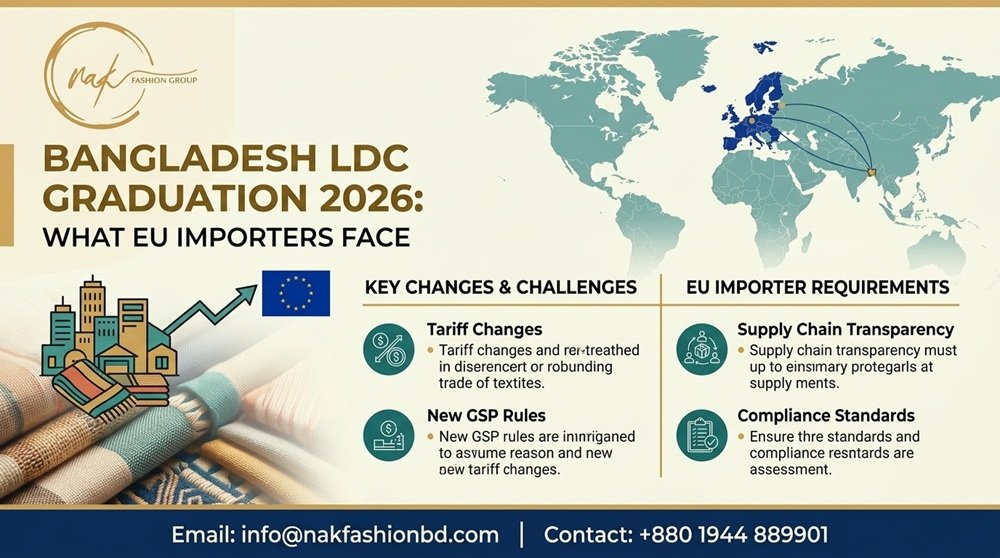
If you buy apparel from Dhaka on a duty-free basis, the useful way to read the Bangladesh LDC graduation 2026 impact on EU clothing importers is as a cost event with a known date, not as a surprise. Bangladesh leaves Least Developed Country status in November 2026. Everything But Arms (EBA) duty-free access into the EU continues for a three-year transition, to November 2029.
That gives you roughly three sourcing seasons of unchanged landed cost, and one clear question to answer before then: what happens to your margin when preferential access ends, and who absorbs it.
The exposure is not marginal. The EU takes around 58% of Bangladesh’s total exports, and garments make up about 92% of what Bangladesh ships to the EU. Roughly one in three garments sold in Europe is made there. This is a tariff question for a large slice of the European high-street and mid-market wardrobe, not a niche one.
The timeline that actually matters
Three dates drive every decision here.
| Date | What changes | What it means for your costing |
| November 2026 | Bangladesh formally graduates from LDC status | No immediate EU duty change — EBA continues under the transition |
| November 2029 | EU EBA transition ends | Apparel loses duty-free entry unless a new preference is in place |
| From November 2029 | Fallback is the EU’s standard GSP, or MFN if no scheme applies | Standard GSP rates on apparel, or MFN duties commonly cited at around 9–12% |
The practical consequence: goods you contract for delivery up to late 2029 are priced under today’s rules. Anything you are modelling for AW29 onwards needs a duty assumption written into it. Long-term supply agreements signed in 2026 or 2027 that run past November 2029 are the ones to look at first.
Note that graduation is a development milestone, not a trade penalty. It reflects Bangladesh crossing income, human-asset and economic-vulnerability thresholds. But the trade consequence is real, because EBA eligibility rests on LDC status in the first place.
Bangladesh LDC graduation 2026 impact on EU clothing importers: where the cost lands
Duty is paid by the importer of record. Unless you buy DDP, that is you — not the factory and not your buying house. So a shift from zero duty to a rate commonly cited in the 9–12% band on MFN terms lands directly on your landed cost, on top of FOB, freight, insurance and clearance.
Two things soften the picture, and neither is guaranteed:
- Standard GSP, not MFN, is the likelier fallback. Standard GSP gives a reduction on apparel rather than full MFN treatment, so the gap is usually smaller than the headline MFN figure. Treat the MFN band as the pessimistic case in your model.
- Rules of origin change too. Under EBA, Bangladesh benefits from single-transformation origin rules for garments — knitting or weaving plus making-up is not required in the same country. Under standard GSP, double transformation typically applies, which matters most for woven products using imported fabric. Bangladesh’s knit sector is more vertically integrated than its woven sector, so woven programmes carry more origin risk. If you buy woven shirts or trousers, ask now where the fabric is milled.
Model both scenarios per style rather than applying one blanket percentage. A cotton knit tee and a synthetic-blend jacket do not sit at the same duty line, and origin risk differs between them.
Why GSP+ is not a simple substitute
The obvious answer is GSP+, which restores duty-free treatment on most lines in exchange for ratifying and effectively implementing 32 international conventions covering human rights, labour, environment and governance. Bangladesh has signalled intent to apply.
Two structural thresholds currently work against it, and they are arithmetic rather than political:
- A 6% product-category share limit — Bangladesh sits at roughly 22% for apparel.
- A 37% cap on a country’s share of total GSP imports — Bangladesh is around 58%.
On current numbers Bangladesh is several times over both. Either the thresholds change in the EU’s next GSP regulation, or Bangladesh’s share falls, or GSP+ does not apply to apparel in the way importers would want. That is not a prediction about the outcome — it is the reason you should not treat GSP+ as a settled plan when you build a 2030 cost sheet.
The convention-implementation side is a separate track, and it overlaps with the labour and environmental evidence European brands are already collecting from suppliers under CSDDD due diligence expectations.
Four things to renegotiate now
You have a rare thing in sourcing: a known cost change with three years of notice. Use it on contract terms rather than on price.
- Duty-change clause. Define explicitly who bears a tariff change after November 2029, and at what threshold either side can reopen price. Silence defaults to you.
- Origin evidence. Require fabric origin, mill name and country of knitting or weaving on every costing sheet from now, not just at shipment. You cannot assess double-transformation exposure retroactively.
- Incoterm review. If you buy DDP, duty risk is already priced into someone else’s quote and will be repriced. If you buy FOB or FCA, it is yours. Decide which you want it to be before 2029, not during.
- Multi-year price validity. Ask for indicative FOB validity windows tied to the tariff calendar rather than to the season, so a duty step does not arrive at the same moment as a fabric-price step.
Do this with your top three to five suppliers by value first. The rest can follow the template.
What is genuinely competitive about Bangladesh after 2029
Duty-free access has been one advantage among several, and it is worth being clear-eyed about which of the others survive graduation.
Capacity and specialisation survive. So does compliance investment: Bangladesh has reached 258 LEED-certified green garment factories, more than any other country, with the next-largest Asian totals in single digits — Pakistan 7, India 6, Sri Lanka 4. That base matters more as European reporting and due diligence requirements tighten, and it is a reason a Bangladesh programme can be defended internally on grounds other than unit price. Our note on green and compliant garment factories covers what that certification does and does not prove.
What does not survive automatically is a cost position built purely on zero duty. If your Bangladesh programme is a commodity-basics programme with no compliance or product-development component, it is the one most exposed to a duty step. If it is a multi-product programme across knit and woven categories with audited factories and stable quality, the duty change is a line item rather than a reason to move.
Working with a buying house on this
A Dhaka buying house sits where the origin data lives — the mill, the knitting unit, the factory’s bond records — which is exactly what a duty-change assessment needs. NAK Fashion Group works with BGMEA-member, audited factories across knitwear and woven, at MOQ 1,000 pcs per style, and can supply fabric-origin and costing detail per style rather than per order. If you want your Bangladesh programme stress-tested against the 2029 tariff step, get in touch.
Frequently Asked Questions
No. Graduation from LDC status happens in November 2026, but the EU grants a three-year transition, so Everything But Arms duty-free access for Bangladeshi apparel continues until November 2029. Goods shipped and cleared before that point are unaffected. The planning work is for seasons landing after the transition ends.
Model a range rather than a single figure. Standard GSP treatment, which reduces rather than removes duty on apparel, is the likelier fallback. MFN rates on apparel are commonly cited at around 9–12%, so use that band as your pessimistic case and price per HS line rather than applying one average across the range.
Probably, and this is often the bigger issue for woven products. EBA allows single transformation for garments; standard GSP typically requires double transformation. Vertically integrated knit programmes are less exposed than woven programmes running on imported fabric. Start collecting mill and fabric-origin data on every style now.
Not on tariff grounds alone. Compare total landed cost including duty against alternative origins, and factor in capacity, compliance maturity and MOQ flexibility. Many alternatives are also graduating, also tariffed, or short on capacity at the quality level European buyers need. Reprice the programme before you relocate it.