

Digital Product Passport for Clothing: What to Collect Now
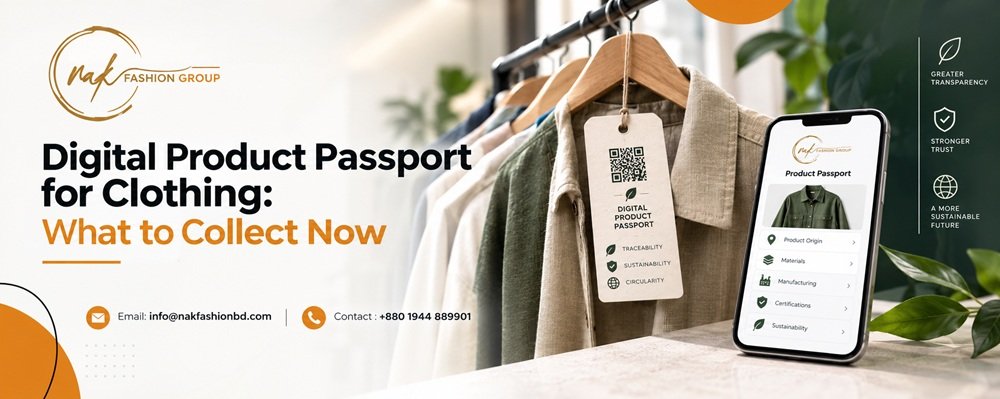
The Digital Product Passport requirements for clothing will not be enforced until around mid-2028, and that is precisely why they are a 2026 problem. A passport is a record of how a specific garment was made. If the fibre origin, the dyehouse name and the chemical test reference were not captured when the goods were in production, they cannot be reconstructed afterwards — the yarn lot is gone and the factory has moved on to next season.
So the question is not when you must publish a passport. It is which fields your current purchase orders already force a supplier to record, and which they quietly do not.
The DPP is mandated by the Ecodesign for Sustainable Products Regulation (ESPR). It applies to apparel and footwear sold in the EU regardless of where the brand is based, so a non-EU brand selling into the EU is in scope on the same terms as a European one.
Timeline: when each piece actually bites
| Milestone | Status | Practical implication |
| ESPR destruction-of-unsold-goods ban | Already in force | Applies now; large enterprises must disclose destruction data 2026/2027 |
| DPP delegated act for textiles | Expected around 2027 | Fixes the exact data fields, format and carrier |
| DPP compliance date | Roughly 18 months after the act, so around mid-2028 | Products placed on the EU market must carry an accessible passport |
| Textile Labelling Regulation revision | New requirements expected late 2027 / 2028 | Fibre composition, origin and sustainability parameters, integrated with DPP |
The delegated act is what turns a general obligation into a specific field list. Until it publishes, nobody can hand you a final schema — and any vendor claiming to sell you a compliant passport today is selling you a container, not a certified format.
That is not an argument for waiting. The categories are already defined in ESPR, and the hard part was never the software.
Digital Product Passport requirements for clothing: the data set
ESPR sets out the categories a passport must carry, accessible through a data carrier such as a QR code on or in the product. For apparel, expect these groups.
| Data group | Typical content | Where it originates |
| Product identity | Model, style, GTIN or equivalent identifier, size, colourway | Brand |
| Material composition | Fibre percentages, blend detail, recycled content and its basis | Yarn supplier / mill |
| Manufacturing processes | Knitting or weaving, dyeing and finishing, printing, washing, making-up — with the site for each | Mill, wet-processing unit, factory |
| Traceability | Country and site at each named stage, back as far as the act requires | Whole chain |
| Chemical compliance | REACH and restricted-substance status, test reports and dates | Testing lab via mill or factory |
| Environmental indicators | Core indicators as defined by the delegated act | Mill and factory data, brand assembly |
| Durability and repair | Care instructions, expected performance, repairability or spare-part information | Brand, informed by testing |
| End of life | Recycling and disposal guidance, presence of disruptive components | Brand |
Two observations from the middle column. Almost nothing on this list originates with the brand alone, and the fields that are hardest to reconstruct — mill identity, dye lot, test report references — are the ones a standard tech pack does not currently ask for. Adding them is a tech pack change, not an IT project.
Who owns each field, in practice
Ownership disputes are what stall passport programmes. Settle them early with a simple rule: the party that performs the process owns the record of it, and the brand owns the assembly and publication.
- The brand owns identity, care and durability claims, end-of-life guidance, and the passport itself — including liability for what it says.
- The buying house or agent typically owns collection and validation, because it is the only party with a relationship at every tier.
- The garment factory owns making-up data, packing, and declared subcontractors for printing, embroidery and washing.
- The mill and dyehouse own fibre content, construction, dye and finish route, and the wet-processing site identity.
- The testing lab owns chemical test reports; the factory owns keeping the reference attached to the correct lot.
The weakest link in apparel is almost always the step above the factory. A Dhaka unit can tell you exactly what it did; whether it can tell you which spinner supplied the yarn depends entirely on whether anyone asked at the time of booking. Vertically integrated units — the kind described in our note on green and compliant factories — usually answer faster, because knitting, dyeing and making-up sit under one roof and one record system.
Capturing it at the factory today
A short, boring checklist covers most of the gap:
- Require the mill name, site and country on every fabric booking, not just the fabric quality reference.
- Require the dyeing and finishing unit by name where it differs from the mill.
- Capture fibre composition to the same precision you will publish, including the basis of any recycled-content figure.
- Attach chemical test reports to the lot, with report number and date, rather than filing them by season.
- Record declared subcontractors for print, embroidery and wash with each PO.
- Keep the factory’s own identifiers — legal name, address, and any bond or export registration reference — as constants against which order data is stored.
- Store all of this against the style and PO, in a field, not in an email thread.
The last point does most of the work. Passport data that lives in correspondence is data you will pay someone to re-key in 2028.
Writing DPP capture into a purchase order
Treat data as a deliverable with the same status as the goods. Useful PO language does four things:
- Names the fields required and the format, with the mill and wet-processing site identified explicitly.
- Sets the delivery point — normally with the pre-production sample or at fabric in-house, not at shipment.
- Gives you a right to verify against mill invoices, transaction certificates or test reports.
- Makes acceptance of the shipment conditional on the data set being complete.
The fourth point is the one that changes behaviour. Where composition or recycled-content claims are involved, the underlying certificates matter as much as the number — see what GOTS and OEKO-TEX each actually prove before you publish a fibre claim to a public QR code.
One consequence worth planning for: a passport is public. Anything you assert about durability, recycled content or environmental performance becomes verifiable by anyone with a phone, which raises the standard of evidence well above what a hangtag has historically required.
Working with a buying house on this
Passport data is collected upstream of the garment factory, which is where a Dhaka buying house is useful — it books the fabric, knows the mill and the dyehouse, and can attach test reports to lots as they are produced. NAK Fashion Group works with BGMEA-member audited factories across knit and woven categories at MOQ 1,000 pcs per style, and can collect DPP fields alongside sampling. To set that up for your next season, contact us.
Frequently Asked Questions
The delegated act setting textile-specific rules is expected around 2027, with compliance roughly 18 months later — so around mid-2028. Until the act publishes, the exact field list and format are not final. The categories under ESPR are stable enough to start capturing data now.
Yes. The obligation attaches to products placed on the EU market, not to the brand’s location. A UK, US or Bangladesh-based seller shipping apparel into the EU is subject to the same requirements as an EU brand, including for online sales.
The economic operator placing the product on the EU market — normally the brand or importer. Suppliers provide data, but the liability for what the passport asserts sits with you. That is why verification rights and lot-level test references belong in the purchase order rather than in a supplier questionnaire.
For a narrow range, yes. A structured spreadsheet keyed to style and PO, with mill, wet-processing site, composition and test references, holds the substance. You will need a compliant carrier and format later, but the expensive part is data collection discipline, not the tool.